
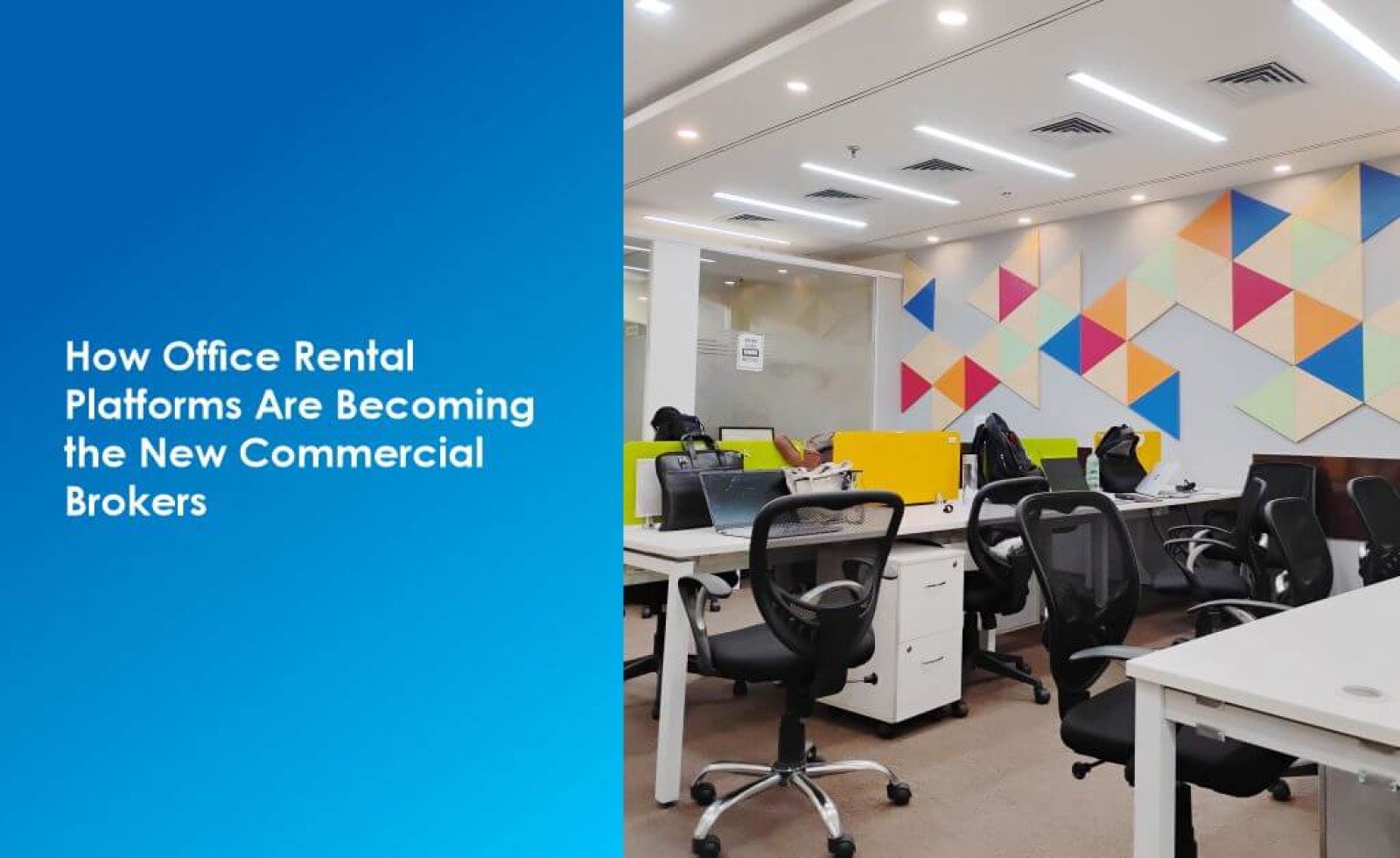
How Office Rental Platforms Are Becoming the New Commercial Brokers

Somewhere in Gurugram, a broker is dialing his fortieth cold call of the day, hoping someone on the other end still needs "2500 sq. ft., Grade A, immediate possession." Meanwhile, three floors up in a startup office, a founder just closed a lease for the exact same space - in eleven minutes, on her phone, without ever speaking to a broker. She scrolled, filtered, verified, and connected directly with the property owner. No commission haggling. No fifteen missed calls. No "let me check and get back to you." Just data, transparency, and a deal done.
This isn't a one-off story anymore - it's becoming the norm. Across India's commercial real estate market, and especially in fast-growing corporate hubs, office rental platforms are quietly doing what once required an entire ecosystem of brokers, sub-brokers, and property consultants. The question isn't whether this shift is happening - it clearly is. The real question is: what does it mean for tenants, landlords, and the brokers themselves? Let's break it down.
The Traditional Broker Model: Why It Worked (And Why It's Struggling Now)
For decades, commercial real estate transactions depended almost entirely on brokers. They held the local knowledge - which building had vacant floors, which landlord was flexible on lease terms, which micro-market was heating up. In a pre-digital world, that knowledge was valuable precisely because it wasn't accessible anywhere else.
But the model had structural weaknesses that became more visible as commercial real estate demand grew more complex:
- Limited inventory visibility - most brokers only had strong relationships with a handful of landlords or buildings, meaning tenants rarely saw the full market
- Commission-driven bias - recommendations were sometimes shaped by which listings paid better commissions, not which spaces genuinely fit the tenant's needs
- Slow, manual processes - physical site visits, printed floor plans, and phone-tag negotiations stretched timelines unnecessarily
- Inconsistent information - carpet area, rental rates, and amenities often varied depending on who you asked
- No standardized comparison - tenants had no easy way to benchmark one office space against another across different sectors or business parks
These gaps didn't just slow things down - they created real cost and opportunity loss for businesses trying to scale quickly. And that's exactly the vacuum that office rental platforms have stepped into.
What Office Rental Platforms Actually Do Differently
At their core, office rental platforms function as digital marketplaces for commercial office space - but calling them "just a listings website" undersells what they've become. Increasingly, these platforms are performing the exact functions a traditional broker used to handle, just faster, more transparently, and at scale.
1. Aggregating Verified Inventory
Instead of relying on one broker's limited network, platforms aggregate office space listings across multiple sectors, business parks, and building types - coworking spaces, managed offices, bare-shell commercial units, and full-floor corporate spaces - all verified with real photos, floor plans, and carpet area details.
2. Enabling Direct Owner-Tenant Connection
Many platforms now allow tenants to connect directly with property owners or authorized listing partners, cutting out layers of sub-brokerage that traditionally inflated costs and slowed communication.
3. Providing Data-Backed Pricing Transparency
Where brokers once quoted rental rates based on informal market knowledge, platforms now show comparative pricing benchmarks - helping tenants understand what's fair for a given sector, building grade, or amenity package.
4. Offering Advanced Search and Filtering
Tenants can filter by budget, carpet area, furnishing status, parking availability, and proximity to metro stations or expressways - replicating (and often exceeding) the filtering a broker would do manually based on a client brief.
5. Reducing Time-to-Decision
With virtual tours, detailed amenity checklists, and instant availability status, businesses can shortlist and finalize spaces in days rather than the weeks it traditionally took through broker-mediated searches.
In effect, these platforms are absorbing the broker's traditional value proposition - market knowledge, curated options, negotiation support - and rebuilding it as searchable, transparent, self-service technology.
Why This Shift Is Accelerating Now
Several converging trends are pushing commercial tenants toward platform-driven leasing rather than broker-first approaches.
Rise of startups and SMEs: Smaller businesses often can't justify paying broker commissions on modest office footprints, making self-serve platforms far more cost-effective.
Hybrid work reshaping demand: Companies are increasingly looking for smaller, flexible, strategically located offices rather than massive centralized campuses - a search pattern that favors granular, filterable platforms over generalist brokers.
Growth of coworking and managed office models: Flexible workspace operators list heavily on digital platforms, making it easier for tenants to compare traditional leases against managed office options side by side.
Increased trust in digital transactions: Just as residential real estate buyers grew comfortable browsing verified listings online, commercial tenants are now equally comfortable evaluating office space digitally before ever stepping foot on-site.
Demand for speed: In competitive business environments, the ability to shortlist and lease office space in days rather than weeks has become a genuine competitive advantage - and platforms simply move faster than traditional broker chains.
Are Brokers Becoming Obsolete? Not Quite - But Their Role Is Changing
It would be an oversimplification to say platforms are eliminating brokers entirely. Large enterprise leases, complex lease negotiations, and highly customized fit-outs still often benefit from experienced human expertise. What's changing is the broker's role within the transaction.
Forward-thinking brokers and consultants are adapting by:
- Using platforms themselves to source verified leads and listings faster than cold outreach
- Focusing on high-value advisory work - lease structuring, negotiation strategy, legal compliance - rather than basic inventory discovery
- Partnering with listing platforms to gain visibility for their exclusive properties among a wider, pre-qualified audience
- Acting as closers, not gatekeepers - since tenants now arrive with platform-sourced shortlists already in hand, brokers who add genuine negotiation value remain relevant
In many ways, platforms aren't destroying the broker ecosystem - they're forcing it to evolve from information gatekeeping toward genuine value-added advisory, much like what happened in other industries once digital marketplaces matured.
What This Means for Tenants and Property Owners
For tenants, this shift translates into faster searches, wider visibility into available inventory, and significantly more negotiating power thanks to pricing transparency. Businesses no longer have to depend on a single broker's limited portfolio - they can compare dozens of verified office spaces across multiple sectors in one sitting.
For property owners and developers, platforms offer direct access to a much larger, more targeted pool of prospective tenants than traditional broker networks alone could provide. Listings stay updated in real time, reducing the frustration of stale or duplicate inquiries, and owners retain more control over how their commercial assets are presented and priced.
For coworking and managed office operators, visibility on dedicated rental platforms has become almost essential - since flexible workspace seekers overwhelmingly begin their search online rather than through broker referrals.
The Road Ahead: Technology-Driven Commercial Leasing
As this transformation matures, expect office rental platforms to incorporate even deeper technology layers: AI-based space recommendations tailored to team size and growth projections, integrated virtual reality walkthroughs, digital lease documentation and e-signing, and predictive pricing models based on historical sector-wise rental data.
The broader trajectory is clear - commercial real estate is following the same digitization path that reshaped residential property search, ride-hailing, and countless other broker-dependent industries before it. The businesses and professionals who adapt early - whether tenants embracing self-serve search, property owners listing directly, or brokers repositioning as advisory experts - stand to benefit the most from this shift.
Conclusion
The role of the traditional commercial broker isn't disappearing overnight, but it's undeniably being reshaped by technology. Office rental platforms are stepping in to do what brokers once did manually - aggregating verified inventory, enabling transparent pricing, and connecting tenants directly with property owners - all faster, and at a scale no individual broker network could match.
This is precisely the space Officekhoj operates in. Built as a dedicated commercial office space platform, Officekhoj brings verified listings, transparent pricing, and direct owner connections together in one place - helping businesses skip the broker bottleneck and find the right office space on their own terms.
Browse Properties on Officekhoj →
For sell, rent, or lease your commercial property then List Your Property on Officekhoj →
Frequently Asked Questions
Q1. How are office rental platforms replacing traditional brokers?
They offer direct access to verified listings, transparent pricing, and instant comparisons - reducing dependency on brokers for basic property discovery.
Q2. Do office rental platforms charge brokerage fees?
Most platforms, including Officekhoj, offer verified listings with minimal or no brokerage, unlike traditional agents who typically charge a percentage-based fee.
Q3. Can businesses trust listings on rental platforms over local brokers?
Yes, provided the platform verifies listings directly with property owners or dealers, offering more transparency than word-of-mouth broker deals.
Q4. Are these platforms suitable for both renting and buying office space?
Yes, most modern office rental platforms support renting, leasing, buying, and even listing office space for sale, all within one portal.
Q5. Will traditional brokers become obsolete because of these platforms?
Not entirely - platforms handle discovery and verification efficiently, but brokers may still assist with negotiations and legal formalities in certain deals.
Please Login to Comments
Login